
When Fantasy Feels Real
I was walking home from primary school. My friends had gone their separate ways, and I kept walking alone. For me, being alone wasn’t a problem; it was a source of excitement. I knew I could finally daydream without the fear of being seen o…
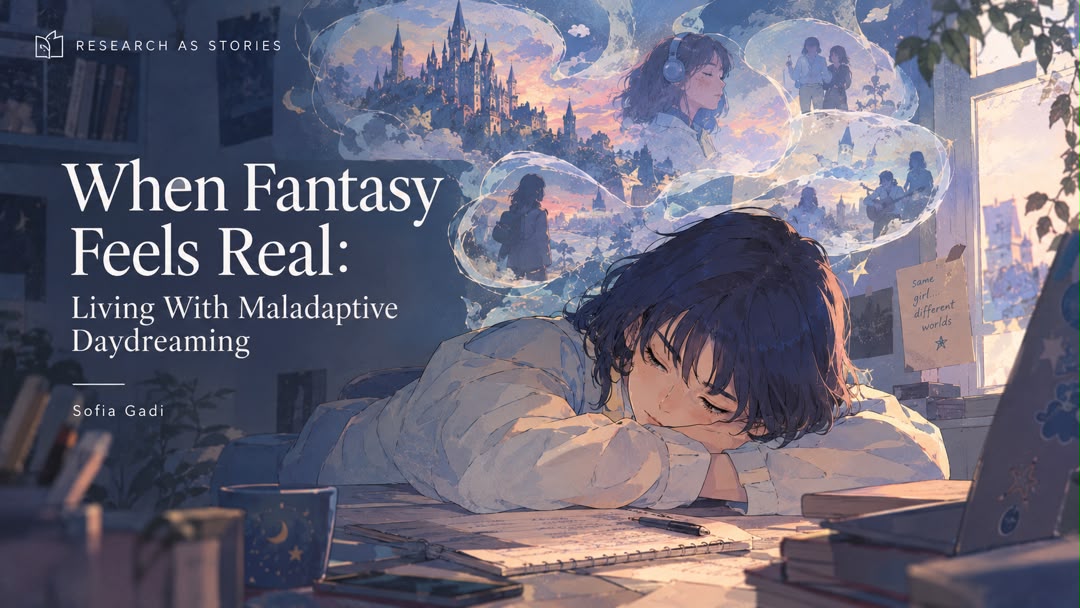
The sound of a car horn pulled me out of my imaginary world.
I was walking home from primary school. My friends had gone their separate ways, and I kept walking alone. For me, being alone wasn’t a problem; it was a source of excitement. I knew I could finally daydream without the fear of being seen or embarrassed.
So, I embarked on my imaginary spaceship and went straight to another realm.
I’ve forgotten what I was dreaming about that day. I only remember whispering some words, moving my hands and body in a certain way, and smiling. I loved what I was experiencing, that deep connection with fantasy. I was, however, so deeply immersed that I hadn’t noticed I had stepped outside the pedestrian crossing and was actually walking on the road.
It was the sound of the car horn that pulled me out of my reverie and brought me back to reality, where I was in danger of being run over.
I don’t quite remember the exact moment my daydreams began, but I know it goes as far back as my childhood. Back when my brain was still developing and my imagination too.
I was a dreamy child. I fabricated my own fantasy world. I decorated it, created its characters, and gave them body, soul and heart. And I interacted with them most of the time. Imaginary scenarios of different genres were consciously unfolding within my mind as I was standing there, my feet on the ground, my body anchored in the real world.
I was daydreaming.
During that brief episode, it was as though only my body remained in the physical world, but my mind was detached, wandering somewhere else. It felt like a moment of disconnection where I lost complete touch with my surroundings. As if all my attention was shifted and directed into an alternative reality.
From that moment on, especially in childhood, many episodes of such disconnection happened. But my love and need for daydreaming didn’t lessen. That need became more and more omnipresent, like an urge one cannot resist, like an itch one cannot ignore for long before scratching it. And even though scratching it excessively would irritate the skin, one keeps on doing it, seeking that sensation of relief.
It was the same with my daydreams.
When daydreaming became a struggle
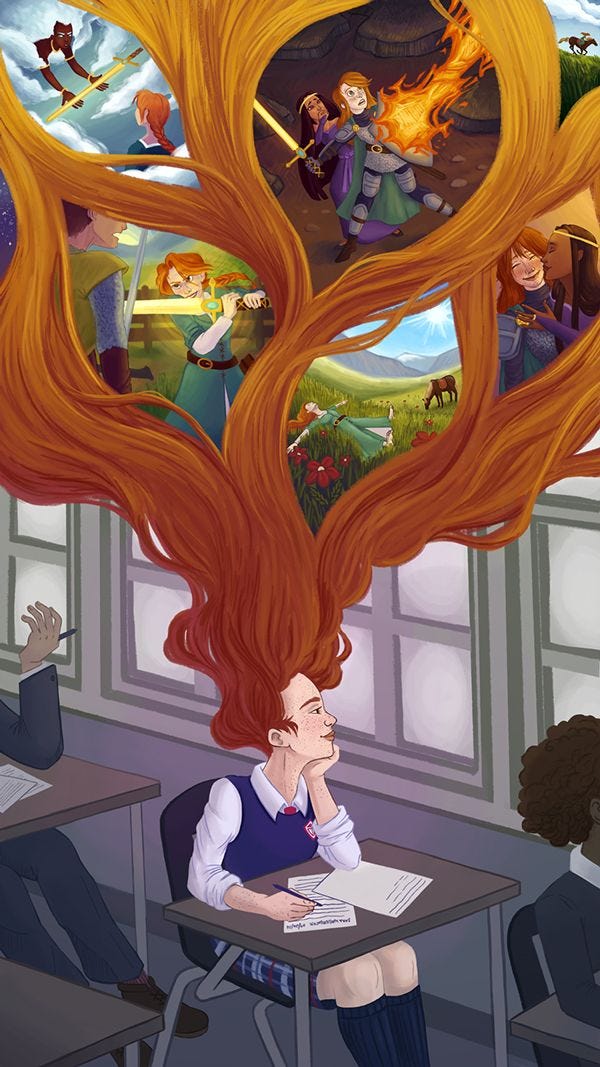
During my teenage years, I started to experience some difficulties with my concentration. I was unable to fully concentrate on a task, without interrupting it to daydream. My schoolwork and exam preparation were repeatedly interrupted, separated by several moments of daydreaming; what I could accomplish in an hour, was prolonged by another hour and so on.
Even though I enjoyed my daydreams, yet after I was done, I was left with a deep feeling of frustration. I was aware that I had wasted time. I couldn’t resist my urges like I promised myself. I was disappointed.
I felt it again, that urge.
There I was in my cozy room. My laptop on, my pen and notebook on my desk. I had meticulously prepared my study program, scheduling every module to be revised. For the next two hours, I was ready to be productive!
I was focused on my assignments. The information seemed to flow smoothly into my mind.
“Maybe this time it’s different.” I thought.
“Maybe I won’t be distracted” my inner monologue went on.
Everything seemed to go as planned. I was fine.
…
Half an hour later, however, in the middle of my busy work, I felt it.
I felt it again—that ghostly parasite hungry for my imagination. Its whispers reached me finally, in an urge no stranger to me. So, I stopped what I was doing and shifted the connection to the imaginary.
I can’t count how many times I got anxious wishing I could have more control over my fantasies. The struggle, I knew, was real. And my experience, I wished, could be explained and shared with people around the world. Because in such moments, when something feels off, one is hungry for answers.
I needed answers.
The compulsive character of my daydreams was my warning sign. I started to notice a pattern. An unhealthy one. A pattern that no longer served as a sweet escape, but more like a forced interference in my important daily activities and overall well-being.
After spending some time researching, I finally found that my experiences matched what is called maladaptive daydreaming (MD).
When imagination becomes maladaptive
Before defining it, let me point out an important distinction: there’s a difference between ordinary daydreaming and maladaptive daydreaming. It’s important to understand when to draw the line between the two.
Perhaps many of you reading this have related to my experience so far. Some might say it’s a normal, common experience. To some extent, that’s true. Daydreaming is common. But there’s a difference between simply letting your mind wander and becoming so absorbed in fantasy that it begins to interfere with your life.
Ordinary daydreaming is a harmless form of mind wandering that most people experience. It can be useful for creativity and imagination. It’s usually brief and easy to stop when something else requires our attention. It doesn’t cause significant distress or interrupt daily activities.
Maladaptive daydreaming, on the other hand, involves vivid, highly detailed and compulsive fantasizing that can significantly disturb a person’s emotional and social life. It may also be accompanied by physical movements, such as gesturing, pacing or mouthing words 1
Dr. Eli Somer coined the term in 20021 And since then, MD has been the subject of substantial clinical research around the world. However, despite the growing research, MD is not yet formally recognized in major diagnostic systems.
Thus, it’s important to note that maladaptive daydreaming is still a research-defined clinical phenomenon with proposed diagnostic criteria rather than an officially established diagnosis 8.
Researchers have developed tools to assess it, including the Maladaptive Daydreaming Scale (MDS), an internationally recognised and standardised instrument that measures the frequency, intensity and functional impact of daydreaming14. Additionally, a structured clinical interview for maladaptive daydreaming (SCIMD) was developed to help clinicians assess its key features8.
Despite these developments, MD remains poorly understood by many clinicians and may be misdiagnosed.
So, where does it belong?

Researchers continue to this day to advocate for the inclusion of MD in diagnostic manuals, but there is no universally established classification yet.
I was relieved when my experience finally had a name and when I discovered that people around the world shared similar experiences. I wasn’t alone. There’s a certain comfort in not being alone.
But the question remains though as to what category should this condition belong to.
Some researchers argue that MD should be recognized as a distinct disorder because of its unique clinical presentation 9. And often its features overlap with those of other disorders, such as attention-deficit/hyperactivity disorder (ADHD), obsessive-compulsive disorder (OCD), or even psychosis 6, 10
However, while ADHD may involve random mind-wandering and sustained inattention, daydreams in MD tend to be more immersive, involving more elaborate plots and characters. The inattention associated with MD may also differ from that observed in ADHD. The two can co-occur, but they may involve different underlying mechanisms. Further research is needed to investigate those differences 6 11
OCD presents another point of comparison. In OCD thoughts are intrusive, unwanted and distressing, whereas daydreams in MD, despite their compulsive-like nature, they’re often voluntary and can be a source of comfort and joy, at least initially 10
Another important distinction concerns the relationship between fantasy and reality. People who experience MD know exactly what is real and what is fiction, even when the fantasies feel emotionally vivid. This distinguishes it from psychotic experiences, where it’s hard to differentiate between what’s real and what’s not 4
MD may also involve distinctive physical behaviors or kinematic elements 12. In my own experience, there was hardly a moment of daydreaming when I wasn’t moving a part of my body, even subtly. I would move my neck from side to side, sometimes just making a quick movement to one side. I moved my shoulders and fingers, and I frowned or smiled depending on the context of my imagined scenarios.
MD has also been discussed as a possible dissociative condition because of its association with intense absorption, reduced awareness of the external environment and the use of fantasy as a means of psychological escape 5.
Do you remember the first story I told you about walking home from school? that deep absorption in my imaginary world made me completely unaware of my surroundings and even put me in danger.
Looking back, it seems to resemble dissociation. However, even though MD shares some features with dissociative experiences, the nature of this relationship remains a subject of research. There are also some important distinctions. For example, MD doesn’t block out memories like in dissociative amnesia. Memories of the fantasies remain overall intact, as well as their autobiographical context. Nor does it split the personality, as occurs in dissociative personality disorder. The daydreamers can have multiple personalities in fantasy, but this doesn’t fragment their identity in everyday life 5.
I have played multiple roles in my fantasies and experienced different emotions. But when the imaginary scenario ended, I was still me.
MD has also been proposed as a potential form of behavioral addiction, as individuals may experience strong urges to daydream, find it pleasurable, and struggle to stop despite its negative impact of daily life 7.
Despite all these findings, further research is still needed to clarify diagnostic boundaries of MD, its relationship with other disorders, and its underlying neurobiological mechanisms. Much remains to be understood about this complex phenomenon.
Another glimpse into my fantasy

Fantasies, my dear fantasies, they attracted me toward them like a magnet. They cut, and they healed.
What made them so addictive? The ability to escape into alternative worlds, their emotional intensity, or the disconnection from reality? Perhaps all of these.
My daydreams weren’t just random, spontaneous thoughts. They were highly elaborated stories, with a different version of myself at the center of them. I would consciously shape every scenario, and although my stories varied, certain themes, I noticed, appeared more frequently than others.
When I was in the car or on the bus, for example, I would often look at the sky and start creating entire scenarios in my head, almost like a movie playing inside my mind. Each character had their own storyline and each played an important part in the overall plot.
Within my fantasy realm, I was often the hero: the person who wanted to save the world, especially girls and women from abuse and oppression. I was a private detective investigating a case of domestic abuse, a prosecutor standing against an entire corrupt judicial system to defend a cause, a person hungry for revenge, or simply a woman who put herself in danger to save her friend.
There were moments when I imagined myself as the victim too, but I struggled to create the perfect hero for me. So, I became the hero instead.
The older I became, the more diverse my daydreams grew. During my teenage years, I often imagined myself as a successful musician who produced meaningful music and became a source of hope and positivity for others, a writer, an adventurer exploring the world, or a world-renowned scientist.
I imagined myself as everything I wanted to become.
These themes weren’t unique to my own experience. Research has identified some recurrent themes in daydreaming, including relationships, family life and social status 2 Fantasies about saving others, being famous or successful have also been described. It is suggested that such fantasies may serve as defense mechanisms to traumatic or distressing real life experiences 13 .
In my case, daydreaming became an escape. It was a way to forget that the real world and its challenges existed. In imagination, I felt that I had complete control over my fate. I could anticipate what might happen and change anything the way I wanted.
As a child, my reality wasn’t always rainbows and sunshine. I often felt scared and hopeless. So, I constructed my own fantasy refuge, as a way to protect myself, as a way to survive. And as I grew older, that refuge grew with me.
Feeling through the imaginary

I was deeply absorbed. I was emotionally immersed in my daydreams. My sensory experiences, too, became part of my fantasies.
Our senses. They connect us to the physical world and they ground us in the feeling of being real. Through our five senses, we are able to engage with and experience the world around us. And with both perception and emotion intertwined, we give meaning to our experiences.
But what happens if this sensory and emotional engagement extends to fantasy, would the imaginary feel real too?
What fascinated me about my daydreams was my ability to experience a wide range of emotions, depending on the scenario I created. Perhaps this was what made daydreaming feel like a part of myself, almost real. My dreams were always accompanied by bodily sensations and powerful emotions. The emotional connection was so strong that I could cry out of sadness, feel anger, or experience joy.
I consider emotion the pillar of my daydreams, the element that kept me attached to them and made them difficult to resist. Most of the time, I just wanted to feel something. And I took advantage of this ability: to turn imagined scenarios into something I could feel.
Physical movements and facial expressions served as emotional enhancers. They helped intensify my emotional immersion.
Music played a role, too.
I would choose the songs that matched the atmosphere of each scenario. Sometimes, however, music itself triggered a daydream, and thus shaped the kind of fantasy I would create.
All experiences I have described so far persisted until my early twenties. Music still triggers my daydreams, but they no longer feel as intense as before. My most intense phases happened during childhood and adolescence.
Perhaps the intensity of daydreams changes with age. Perhaps it also varies in severity from one person to another. Much remains to be understood about the psychological and neurological mechanisms of MD.
For a long time, I never wanted to stop daydreaming, even when I became anxious about how much it distracted me. And to be truly honest, I still don’t know exactly what made it less intense over time. Perhaps it was the transition to a safer, more secure environment, and the development of healthier habits.
Whatever the reasons behind these changes, I genuinely wish for maladaptive daydreaming to be better understood. Many people are still struggling, perhaps more than I ever did. And they’re experiencing real difficulties in their relationships, work and their everyday lives.
We still need to better understand what makes daydreaming become maladaptive and how effective, targeted therapies can be developed for those who need them. Not to eliminate the capacity to imagine, but to have better control over those fantasies, so that imagination remains a beautiful fuel to our creativity rather than a source of distress.
References:
1. Somer, E. Maladaptive Daydreaming: A Qualitative Inquiry. Journal of Contemporary Psychotherapy 32, 197–212 (2002). https://doi.org/10.1023/A:1020597026919
2. Somer, E., Somer, L., & Jopp, D. S. (2016). Parallel lives: A phenomenological study of the lived experience of maladaptive daydreaming. Journal of trauma & dissociation: the official journal of the International Society for the Study of Dissociation (ISSD), 17(5), 561–576. https://doi.org/10.1080/15299732.2016.1160463
3. Ricci, F., Valentini, C. P., Torales, J., Caycho-Rodríguez, T., Hualparuca-Olivera, L., Castaldelli-Maia, J. M., & Ventriglio, A. (2025). When imagination turns into disorder: the case of maladaptive daydreaming. International review of psychiatry (Abingdon, England), 37(6-7), 706–718. https://doi.org/10.1080/09540261.2025.2562185
4. Somer, E., Herscu, O., Samara, M., & Abu-Rayya, H. M. (2025). Maladaptive Daydreaming and Psychopathology: A Meta-Analysis. International journal of psychology : Journal international de psychologie, 60(2), e70027. https://doi.org/10.1002/ijop.70027
5. Soffer-Dudek, N., Somer, E., Spiegel, D., Chefetz, R., O’Neil, J., Dorahy, M. J., Cardeña, E., Mamah, D., Schimmenti, A., Musetti, A., Boon, S., van Dijke, A., Ross, C., Nijenhuis, E., Krause-Utz, A., Dell, P., Gold, S. N., Pietkiewicz, I., Silberg, J., Steele, K., … Middleton, W. (2025). Maladaptive daydreaming should be included as a dissociative disorder in psychiatric manuals: position paper. The British journal of psychiatry : the journal of mental science, 226(4), 238–242. https://doi.org/10.1192/bjp.2024.279
6. Theodor-Katz, N., & Soffer-Dudek, N. (2025). Differential diagnosis between maladaptive daydreaming and ADHD: Immersive daydreaming is not simply inattention. International journal of clinical and health psychology : IJCHP, 25(3), 100616. https://doi.org/10.1016/j.ijchp.2025.100616
7. Pietkiewicz, I. J., Nęcki, S., Bańbura, A., & Tomalski, R. (2018). Maladaptive daydreaming as a new form of behavioral addiction. Journal of behavioral addictions, 7(3), 838–843. https://doi.org/10.1556/2006.7.2018.95
8. Somer, E., Soffer-Dudek, N., Ross, C.A., & Halpern, N. (2017). Maladaptive Daydreaming: Proposed Diagnostic Criteria and Their Assessment With a Structured Clinical Interview. Psychology of Consciousness: Theory, Research, and Practice, 4, 176–189.
9. Chhapiwala, Nakiya, Beyond Misdiagnosis: Maladaptive Daydreaming as a Distinct Psychiatric Condition (August 07, 2026). Available at SSRN: https://ssrn.com/abstract=7264580 or http://dx.doi.org/10.2139/ssrn.7264580
10. Salomon-Small G, Somer E, Harel-Schwarzmann M, Soffer-Dudek N. Maladaptive Daydreaming and Obsessive-Compulsive Symptoms: A confirmatory and exploratory investigation of shared mechanisms. J Psychiatr Res. 2021 Apr;136:343-350. doi: 10.1016/j.jpsychires.2021.02.017. Epub 2021 Feb 15. PMID: 33636690.
11. Theodor-Katz, N., Somer, E., Hesseg, R. M., & Soffer-Dudek, N. (2022). Could immersive daydreaming underlie a deficit in attention? The prevalence and characteristics of maladaptive daydreaming in individuals with attention-deficit/hyperactivity disorder. Journal of Clinical Psychology, 78, 2309–2328. https://doi.org/10.1002/jclp.23355
12. Somer, Eli. (2023). Body Movements During Maladaptive Daydreaming: A Thematic Analysis of Asynchronous Email Interviews. Journal of Anomalous Experience and Cognition. 3. 267-299. 10.31156/jaex.25004.
13. Somer, E., Abu-Rayya, H. M., & Brenner, R. (2021). Childhood Trauma and Maladaptive Daydreaming: Fantasy Functions and Themes In A Multi-Country Sample. Journal of trauma & dissociation : the official journal of the International Society for the Study of Dissociation (ISSD), 22(3), 288–303. https://doi.org/10.1080/15299732.2020.1809599
14. Somer, E., Lehrfeld, J., Bigelsen, J., & Jopp, D. S. (2016). Development and validation of the Maladaptive Daydreaming Scale (MDS). Consciousness and cognition, 39, 77–91. https://doi.org/10.1016/j.concog.2015.12.001