
Why The Night Sky Isn’t Blindingly Bright
Picture yourself standing in the middle of an endless forest. No matter which way you turn, your eyes eventually land on a tree trunk. The view should be solid wood in every direction. Now swap the trees for stars scattered evenly through i…
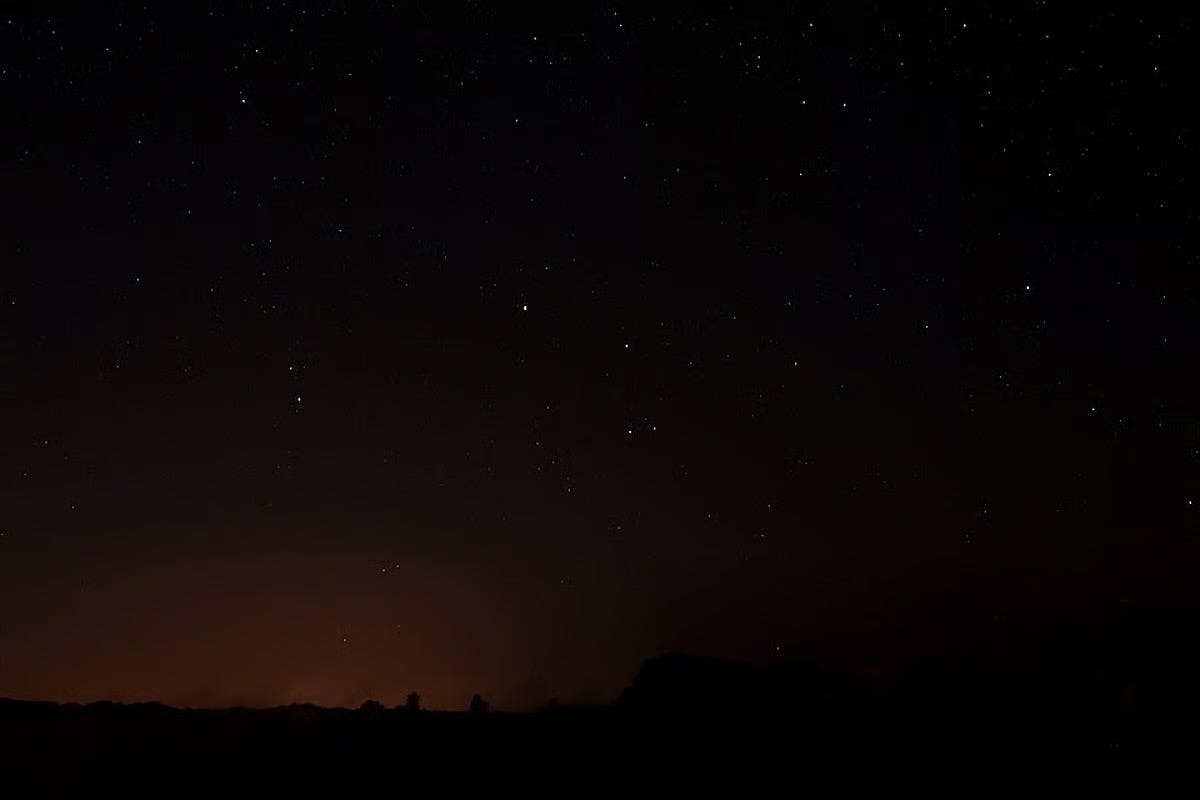
Picture yourself standing in the middle of an endless forest. No matter which way you turn, your eyes eventually land on a tree trunk. The view should be solid wood in every direction. Now swap the trees for stars scattered evenly through infinite space. The night sky ought to blaze as bright as the surface of the Sun—roughly 6,000 °C. Yet when you step outside after sunset, the sky is dark. That mismatch is one of the oldest puzzles in cosmology: Olbers’ paradox, Which states that if the universe were infinite, eternal, static, and uniformly filled with stars, the night sky should be uniformly bright but its observed darkness shows these assumptions are false.
The reasoning is almost too clean. Light from a single star falls off as the square of distance. But the number of stars in a thin spherical shell grows as the square of that same distance. The two effects cancel. Every shell of stars should dump the same amount of light onto Earth. Stack infinitely many shells and the sky saturates with starlight. We should feel as if we live inside a hollow furnace whose walls glow at solar temperature. We do not. Why?
A puzzle older than its name
Johannes Kepler spotted the problem in 1610. Edmond Halley and Jean-Philippe Loys de Chéseaux wrote about it in the 1700s. Heinrich Wilhelm Olbers popularized it in 1823, and the paradox carries his name even though he was far from the first. For centuries the darkness of the night sky sat there as an uncomfortable fact that refused to fit the idea of an infinite, eternal, static universe full of stars.
Ideas that sound good but don’t work
Interstellar dust might soak up the light. That fails because the dust would heat up and re-radiate the energy. In equilibrium it would glow just as brightly as the stars it hides. A finite number of stars also fails: modern surveys reveal hundreds of billions of galaxies, each packed with hundreds of billions of stars. The total is still large enough that the sky should be bright if those stars had shone forever. Clustering stars into fractal patterns leaves empty lines of sight in principle, but on the largest scales the universe looks remarkably uniform, so this escape hatch has little observational support.
The two facts that actually solve it
Modern cosmology rests on two measured facts that together kill the paradox.
1. The universe is young and so are its stars. Light travels at a finite speed. The best measurements of the cosmic microwave background (Planck Collaboration, 2018/2020) put the age of the universe at roughly 13.8 billion years. Anything farther away than that age times the speed of light has not yet had time to send its light to Earth. We sit inside a finite observable bubble. Outside that bubble, stars may exist, but their photons are still on the way.
Even inside the bubble the stars themselves have finite lifetimes. They form, fuse hydrogen, and die. The total energy they can release is limited by the amount of ordinary matter and by the efficiency of nuclear fusion (about 0.7 percent of rest-mass energy). Edward Harrison showed decades ago that even if every atom in the cosmos were converted into starlight, the night sky would still fall far short of solar brightness. There simply is not enough fuel.
Calculations confirm the ranking. The finite age and limited stellar energy cut the expected brightness by many orders of magnitude—roughly a factor of 10¹⁰. That is the dominant reason the sky is dark.
2. Space is expanding. As light crosses expanding space its wavelength stretches, cosmological redshift. Photons lose energy. Visible light from distant galaxies shifts into the infrared and beyond. Detailed calculations (Wesson and others) show that expansion alone dims the integrated starlight by only a modest factor of about two. Helpful, but secondary. The finite age does the heavy lifting. Subir Sarkar and Bryn Jeffries put the numbers plainly in a 2002 Physics World letter: expansion reduces intensity by a factor of roughly two, far short of the factor of 10¹⁰ needed to explain the darkness. The correct explanation lies with the finite age of the universe and of the stars. Even the deepest Hubble images, looking back about 10 billion years, show galaxies covering only about 1 percent of the sky.
Edwin Hubble discovered in 1929 that distant galaxies are receding from us, and that the furthest galaxies are receding at the fastest rate. This is cosmological redshift at work: the further away a galaxy is, the more expanding space lies between us and it, so the faster it appears to recede. Light from these distant galaxies is stretched to longer wavelengths as it crosses that expanding space. For stars, this shifts visible light into invisible infrared and radio waves, essentially making them disappear.
The sky that is bright—just not to our eyes
There is one direction in which the sky really is uniformly bright: the microwave band. The cosmic microwave background is the leftover glow from the hot early universe. Its temperature today is 2.725 K. To human eyes that radiation is invisible, which is why the night looks black. The same expansion that redshifts starlight also cooled this primordial radiation from thousands of degrees to a few degrees above absolute zero, making the universe friendly to life as we know it.
In that sense the sky is bright after all, just at wavelengths our eyes never evolved to see.
Why the darkness matters
Olbers’ paradox is no longer a paradox. It is a quantitative success of the standard cosmological model. The darkness of the night sky is direct evidence that the universe has a finite age, that stars have finite fuel, and that space itself is expanding. What looks like emptiness is actually a window onto cosmic history. Every time you look up at a dark sky you are seeing the finite lifetime of the stars and the finite age of everything.
REFERENCES
Planck Collaboration (2020). Planck 2018 results. VI. Cosmological parameters. Astronomy & Astrophysics, 641, A6. arXiv:1807.06209
Knutsen, H. (1997). Darkness at night. European Journal of Physics, 18(4), 295–302. DOI: 10.1088/0143-0807/18/4/010
Harrison, E. R. (1965). Olbers’ Paradox and the Background Radiation Density in an Isotropic Homogeneous Universe. Monthly Notices of the Royal Astronomical Society, 131(1), 1–12. DOI: 10.1093/mnras/131.1.1
Wesson, P. S. (1991). Olbers’s paradox and the spectral intensity of the extragalactic background light. The Astrophysical Journal, 367, 399–406. DOI: 10.1086/169638
Wesson, P. S., Valle, K., & Stabell, R. (1987). The Extragalactic Background Light and a Definitive Resolution of Olbers’s Paradox. The Astrophysical Journal, 317, 601–606. DOI: 10.1086/165306
Davis, T. M., & Lineweaver, C. H. (2004). Expanding Confusion: Common Misconceptions of Cosmological Horizons and the Superluminal Expansion of the Universe. Publications of the Astronomical Society of Australia, 21(1), 97–109. DOI: 10.1071/AS03040
Conselice, C. J., Wilkinson, A., Duncan, K., & Mortlock, A. (2016). The Evolution of Galaxy Number Density at $z < 8$ and Its Implications. The Astrophysical Journal, 830(2), 83. DOI: 10.3847/0004-637X/830/2/83
Prša, A., Harmanec, P., Torres, G., Mamajek, E., Asplund, M., Capitaine, N., et al. (2016). Nominal Values for Selected Solar and Planetary Quantities: IAU 2015 Resolution B3. The Astronomical Journal, 152(2), 41. DOI: 10.3847/0004-6256/152/2/41
Fixsen, D. J. (2009). The Temperature of the Cosmic Microwave Background. The Astrophysical Journal, 707(2), 916–920. DOI: 10.1088/0004-637X/707/2/916
Dicke, R. H., Peebles, P. J. E., Roll, P. G., & Wilkinson, D. T. (1965). Cosmic Black-Body Radiation. The Astrophysical Journal, 142, 414–419. DOI: 10.1086/148306
Sarkar, S., & Jeffries, B. (2002). The solution to Olbers’ paradox. Physics World, 15(10), 17. DOI: 10.1088/2058-7058/15/10/27